The Spatialized Prisoners Dilemma Model
The standard Prisoner’s Dilemma
The Prisoner’s Dilemma (first described in 1950 by Albert W. Tucker) is a classic model in game theory. It presents a situation in which two players would be better off cooperating, but where, in the absence of communication between them, each chooses to defect if the game is played only once. The reason for this is that, if one cooperates and the other defects, the cooperator is strongly penalized. However, if both players defect, the outcome is less favourable to them than if both had chosen to cooperate.
Tucker imagines two prisoners (accomplices to a crime) held in separate cells who cannot communicate with one another. The prison authorities offer each prisoner the following choices:
- if only one of the two prisoners betrays the other, he is released, whilst the second receives the maximum sentence (3 years);
- if both betray each other, they will be condemned to a lighter sentence (2 years);
- if both refuse to betray the other, the sentence will be the minimum (1 year), due to lack of evidence in the case file.
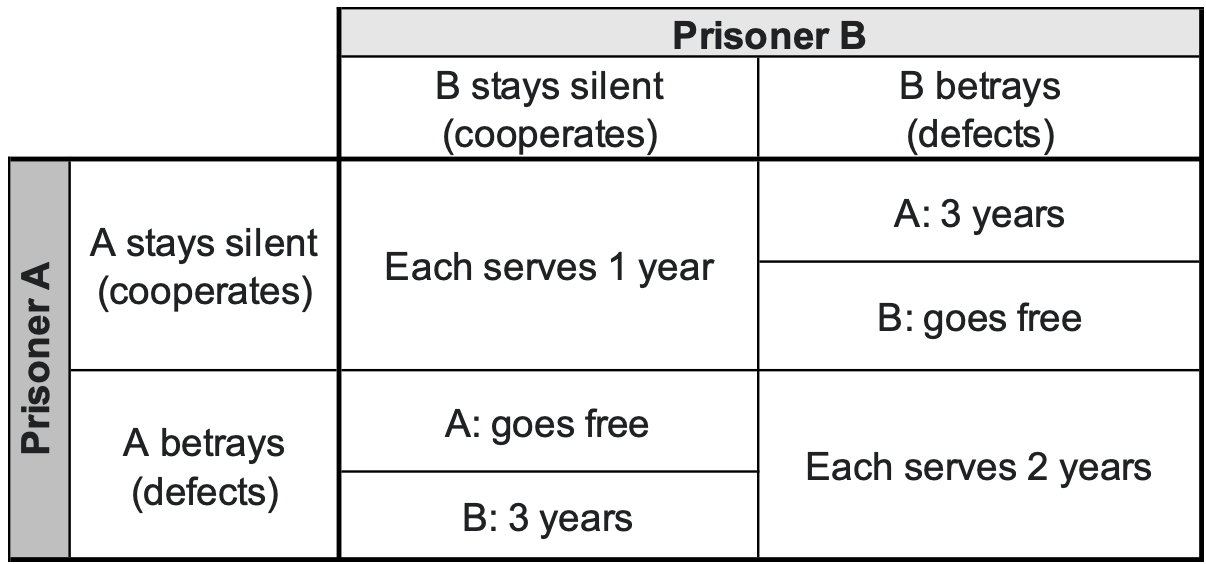
The payoff for the different configurations are such that from an individualist point of view, its better to defect (whatever the strategy of the opponent, the best individual payoff corresponds to the "defect" strategy), whereas from a collective point of view, its better to cooperate (the sum of the two individual payoffs is maximal for the configuration "cooperate" vs "cooperate"). Defection always results in a better payoff than cooperation, so it is a strictly dominant strategy for both players. Mutual defection is the only strong Nash equilibrium in the game. Since the collectively ideal result of mutual cooperation is irrational from a self-interested standpoint, this Nash equilibrium is not Pareto efficient.
The Spatialized Prisoners Dilemma Model
Here, the famous game theory "Prisoners Dilemma" model is spatialized: each cell (of a Cellular Automata) stands for a player. With a Moore neighbourgood (8), the boundaries are "periodic" (toroidal spatial grid). At each time-step, the strategy of the players being set, each player perform 9 games: with its 8 neighbours and also with itself. The total payoff is then compared to the total payoffs of the 8 neighbours players. If one of them is higher than the personal one, then the corresponding strategy will be adopted for the next time-step. In such a context, at the global level, does one of the two strategies invade the other ???...
IN DPS, the payoffs matrix is the following:
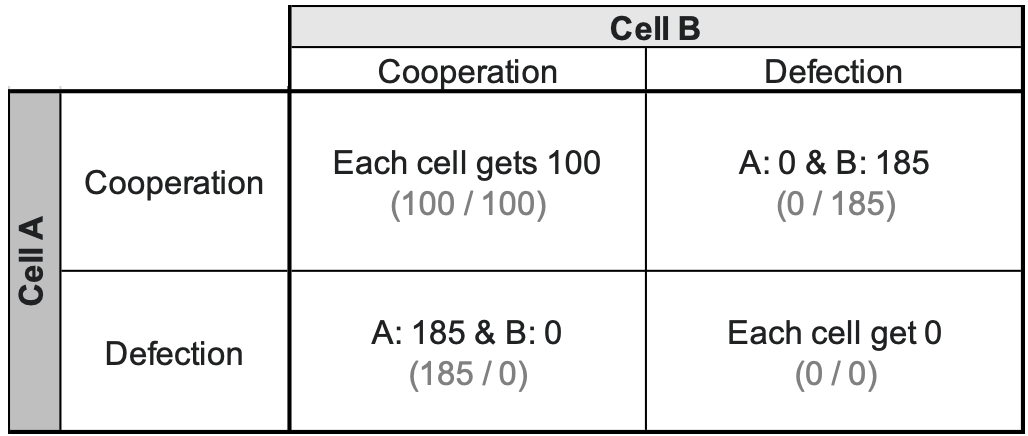
At start, the grid size is 61x61 (full of cooperators) and one defector is initially located in the center of the grid. The movie displayed below shows the intrusion of one defector in a world of cooperators...
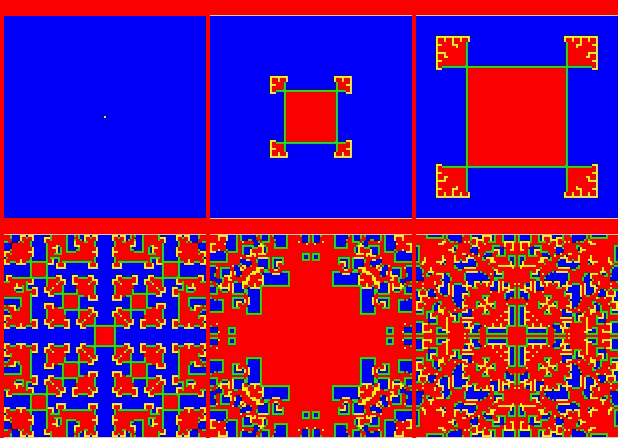
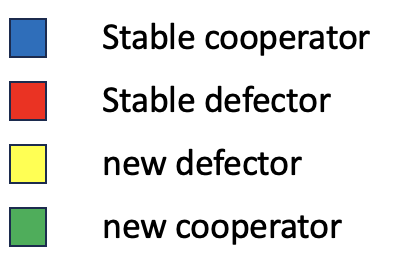
The "stable defectors" appear in red, or yellow for "previous cooperators" just turning into defectors. The "stable cooperators" appear in blue, or in green for "previous defectors" just turning into cooperators.
How to install it?
To install the model, you must first get a latest version of Cormas platform by following the instructions at Cormas GitHub (in this experiment, we used the version 8735b99 but more recent versions should also work). Then open the Playground (Ctrl+OW) in your image and execute the following Metacello script (select it and press Do-it button or Ctrl+D):
Metacello new
  baseline: 'Spatialized-Prisoners-Dilemma-model';
  repository: 'github://cormas/Spatialized-Prisoners-Dilemma-model/src';
  load.
Go to the GitHub page of SPD: https://github.com/cormas/Spatialized-Prisoners-Dilemma-model.git or visite the SPD page on Cormas VW